Wherever there's an LV or MV control panel, there's a feeder worth watching.
SnifferBots is built for both existing and new low-voltage (LV) and medium-voltage (MV) control panels and switchboards — installed inside the feeder compartment, with no interference to the switchgear's own built-in protection.
Existing panels & switchboards
Retrofit SnifferBots into LV & MV panels already in service. Installation sits inside the feeder compartment and doesn't touch the switchgear's inbuilt protection releases — no need to re-certify or redesign what's already installed.
New panels & switchboards
Specify SnifferBots into new control panels and switchboards at build time, so every feeder compartment is monitored from day one.
Low Voltage control panels
The distribution panels and switchboards that carry power through most industrial, commercial and residential buildings — exactly where feeder compartments accumulate the heat, humidity and dust that SnifferBots is built to catch.
Medium Voltage control panels
Higher up the distribution chain, where a fault carries more consequence — and where predictive, per-feeder monitoring matters even more.
Anywhere power distribution can't afford to fail
LV & MV control panels sit behind almost every building and process that depends on continuous power — these are the kinds of sites where per-feeder monitoring earns its keep.
Industrial & manufacturing plants
Production lines where an unplanned trip means real down-time.
Commercial buildings & facilities
Offices, IT parks and mixed-use developments running on dense LV distribution.
Data centres & critical infrastructure
Environments where uptime and early warning both matter enormously.
Utilities & power distribution
MV switchgear and substations feeding the network onward.
Hospitals & institutions
Sites where power continuity is tied directly to safety.
Malls & public infrastructure
High-footfall spaces where fire risk carries an outsized consequence.
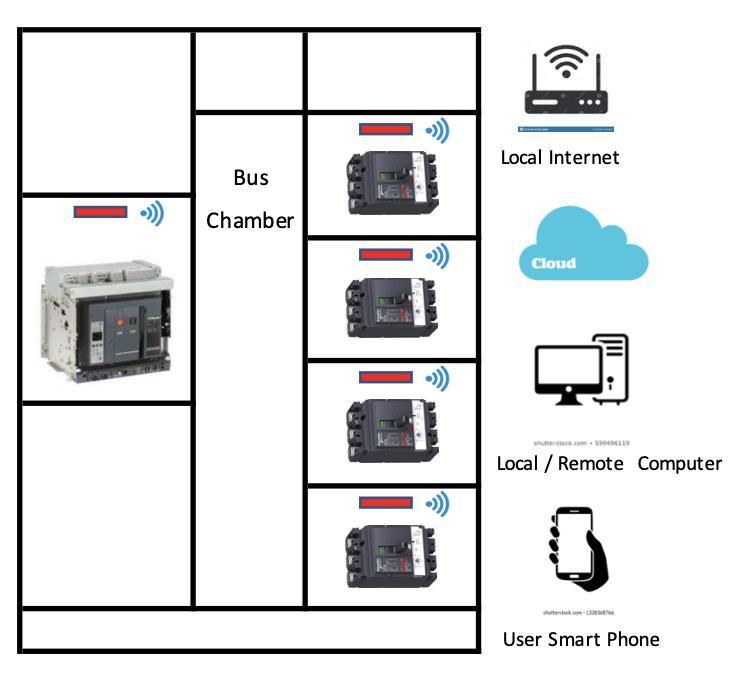
Easy installation, zero interference.
A SnifferBots unit is fitted inside each feeder compartment and wired to the shunt coil, with no interference to the switchgear's own protection releases. From there it's a client account, a Wi-Fi connection, and you're monitoring in real time.
See the full 8-step process