Sensing hardware, smart software, and a shunt-trip that acts on its own.
Each SnifferBots unit lives inside a feeder compartment, reads the conditions around it, and works with a cloud application to warn you — or act — long before a fault becomes a fire.
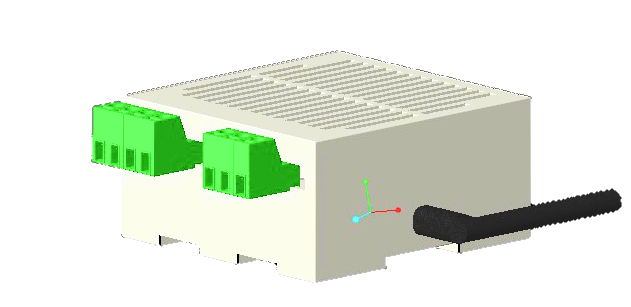
One unit per feeder compartment.
- Power input
- 110–230V AC, wide-band, surge protected
- Onboard sensors
- Temperature, humidity & gas — plus an ambient sensor probe
- Connectivity
- Wi-Fi to cloud, two-way, with fast auto-reconnect after power resumes
- Switching
- Onboard relay for shunt-trip, with inbuilt anti-pumping protection
- Backup
- Onboard data storage when offline · real-time clock with battery back-up
- Updates
- Over-the-air (OTA) programming
- Alerts
- Onboard buzzer for trip & connectivity intimations
Built as hardware you can trust, and software your team will actually use.
Hardware
Specially designed solid-state product. Works on wide-band 110–230V AC input, protected from surges.
Onboard sound buzzer for intimations about trips & connectivity issues.
Onboard real-time clock (RTC) with battery back-up for accurate, always-on timestamps.
Every unit connects an ambient temperature sensor; the system auto-detects it for dynamic protection algorithms.
Onboard relay for shunt-trip feeder tripping, with an inbuilt anti-pumping feature.
Hardware supports over-the-air programming for future updates.
Onboard storage keeps logging when a unit is powered but not connected — so you're never blind to a blank zone.
Built-in proactive trip logic: even with no internet or hub connectivity, hardware can self-generate a trip command in a critical situation.
Software
A purpose-built, web-based application designed around real UX & UI, not an afterthought.
Cloud-based — accessible, and controllable, from anywhere in the world.
Holds your entire electrical distribution system — projects, panels, feeders and authorised users — for future planning and emergency response.
Always-on live notifications keep you alert to feeders in warning, critical, or inactive zones — click straight through to the panel's full detail.
Authorised users can trip a feeder directly from the live notification screen, with command-execution confirmation.
Full feeder-wise trip history by user or system, date & time stamped — with room to log comments and experience for next time.
More capability is added continuously to keep the whole system reliable and genuinely intelligent for the user.
Simple, effective architecture — from feeder to phone.
Set up the client account
Projects, panels and feeders are entered into the SnifferBots web application, along with encrypted, authorised user access.
Install per feeder
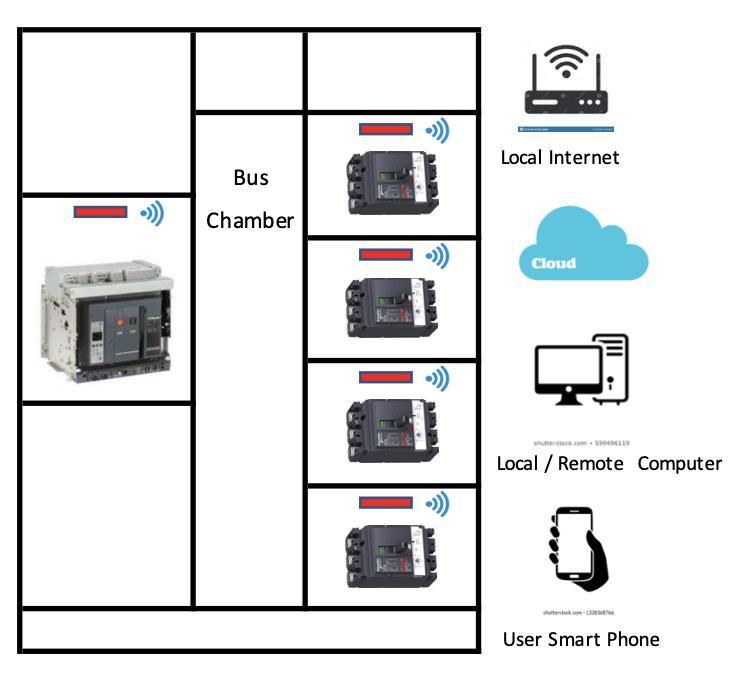
Each SnifferBots unit — with onboard gas, humidity & temperature sensors — is installed inside its feeder compartment on a 230V AC, 50Hz supply.
Wire the shunt coil
The feeder's shunt coil is wired to SnifferBots, with anti-pumping built in to prevent contact chatter.
Connect to Wi-Fi
Units join your Wi-Fi network for two-way, cloud-connected communication.
Start monitoring
SnifferBots begins collecting and sending real-time data, so you can view the live status of every panel.
Analyse dynamically
The application's algorithms read and analyse feeder conditions with sensors working independently and in combination, judging the situation in advance.
Alert instantly
Situations reach your PC and mobile via email & SMS as a clear colour-coded signal. Authorised users can switch a feeder off directly from that alert.
Act on its own, if needed
If the feeder reaches a critical limit and nobody is reachable — no valid internet, a faulty PC, server, or phone — SnifferBots can generate its own proactive trip to stop the problem going further.
One glance tells you exactly where you stand.
Sensor combinations are read continuously and translated into one of three plain-language signals — sent straight to PC and mobile by email and SMS.
Green — Normal
Conditions are healthy. No action needed.
Orange — Alarming
Something's drifting outside the healthy range. Time to take a look.
Red — Emergency
Critical limits reached. Trip the feeder remotely — or let SnifferBots do it for you.
Control is available from the user's mobile or PC to switch off a particular feeder in an extreme condition, whenever it's connected to the system over a valid internet connection.
Built for existing panels — ready for new ones.
This solution works for both existing LV & MV control panels/switchboards and new ones being built today. Installation sits inside the feeder compartment and does not interfere with the switchgear's own built-in protection releases.
See applicationsExisting panels
Retrofit into LV & MV control panels and switchboards already in service.
New panels
Specify it into new control panels and switchboards at build time.